
Repair Blog · Jupiter, FL
Jupiter Power Surges and Washer Boards
Storm-season surges are the number one killer of washer control boards in Jupiter — and the damage often shows up days later. Here are the symptoms, the post-outage checks, and the protection that actually works.
By the Jupiter Washer Pros team · October 22, 2026
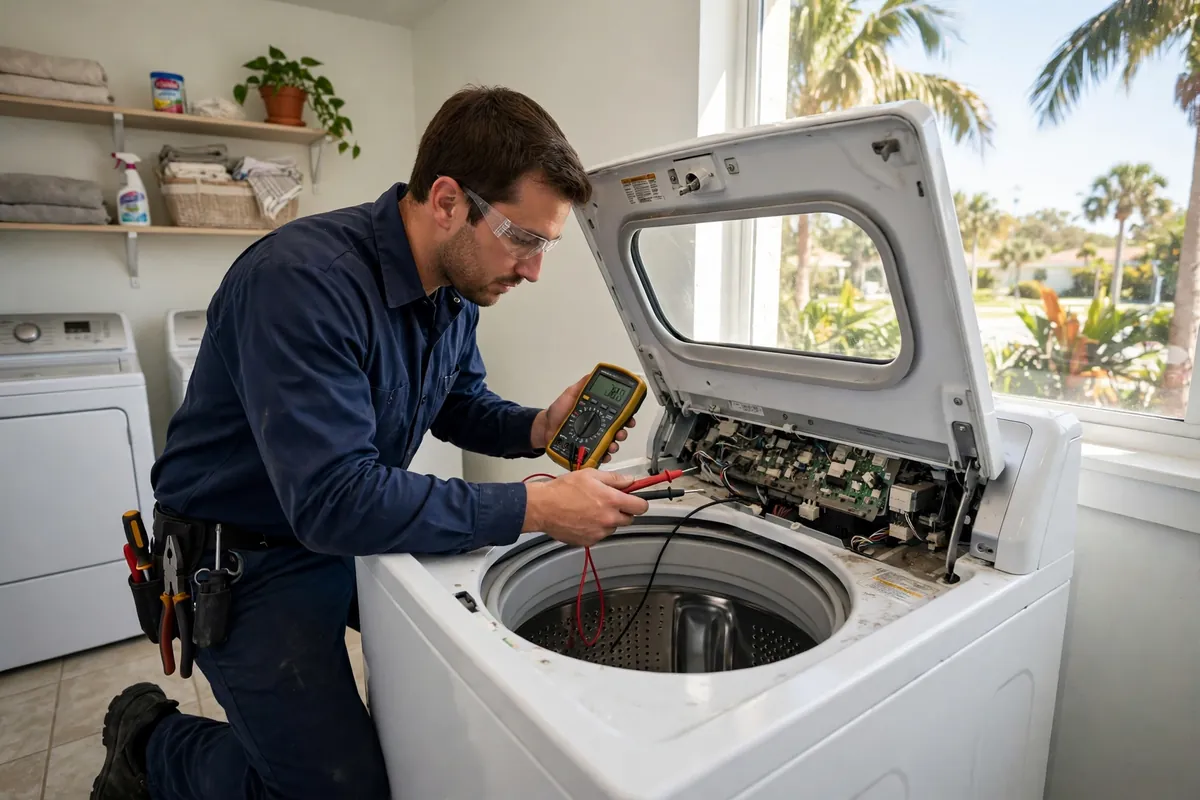
Yes — a power surge can absolutely kill your washer's control board, and in Jupiter it is one of the most common causes of board failure we see. When storm-season lightning or a utility flicker sends a voltage spike through your home, the delicate electronics in a washer absorb it first. Sometimes the machine dies on the spot; more confusingly, it often limps along for days before error codes, dead displays, or random shutdowns appear. This guide explains what is happening inside the board, what to check after an outage, and how to protect the next board — whether that is a replacement or the one you already own.
How does a surge actually damage a control board?
Modern washers are run by an electronic control board — a small computer that takes your settings, reads the sensors, and switches the motor, valves, and drain pump on and off. Those circuits are designed for a narrow, steady voltage. A surge slams them with far more, for a fraction of a second. Components on the board — capacitors, relays, triacs, the processor itself — either fail instantly or are weakened in ways that only show up under load later. That delayed failure is why a washer can seem fine on Tuesday and refuse to start on Friday after Monday's storm. It is also why surge calls spike across Jupiter in the days following a bad storm, not just during it.
Which washer parts are most at risk?
- •Washer control boards — the board runs everything from the door lock to the motor; see washer control board repair for the common failures.
- •Door locks and lid switches — a surge-weakened board can fail to engage the lock, so the cycle never starts; see washer not starting for the symptoms.
- •Washer motors and drain pumps — when the board's output relays fail, the motor or pump never gets power even though both test fine; see drain pump repair.
- •Washer displays and sensors — a weakened board stops cycles mid-run or ignores the control panel entirely.
Older, purely mechanical washers with timer dials shrug off surges far better. The smarter the washer, the more board it has to lose. Seasonal homes around Jonathan's Landing and Admirals Cove face an extra twist: machines sit plugged in and unattended all summer, riding out every storm with nobody home to unplug them.
What are the symptoms of a surge-damaged board?
- •Dead or flickering display, or a control panel that lights up but ignores buttons
- •Error codes that appear after a storm, sometimes different ones on different days
- •Intermittent faults — the machine works in the morning, fails in the evening, works again tomorrow
- •Random behavior: cycles stopping mid-run, fills that never start, or a spin that quits halfway
- •Delayed failure — any new electronic misbehavior that begins within a week or so of a storm or outage
- •A faint burnt-electronics smell near the control panel, or visible scorch marks if the panel is opened
Intermittency is the signature. A worn pump fails and stays failed; a surge-weakened board fails creatively, which is why post-storm diagnosis matters — guessing at parts gets expensive fast. Typical board costs are in the washer repair cost guide.
What should you check after an outage before calling anyone?
Work through this list once power is stable — it fixes more post-storm "failures" than you would expect:
- •Wait 10–15 minutes. Many washers have built-in delay protection after power returns.
- •Check the breaker panel. Surges trip breakers. Reset any tripped breaker fully off, then on.
- •Try a hard reset. Unplug the washer (or switch its breaker off) for a full five minutes, then restore power. Boards that are "stuck" rather than damaged often come back cleanly.
- •Check the outlet with something simple. Plug in a lamp or phone charger to confirm the outlet itself is live — dead outlets and tripped GFCI receptacles (common in laundry rooms) mimic dead washers.
- •Note the timeline. If you call us, "it started two days after the storm" is genuinely useful diagnostic information — tell us.
If the washer is still dead, coded, or misbehaving after those steps, the board itself has likely taken damage, and further resetting will not help it.
Can a surge-damaged board be repaired, or only replaced?
Honestly: in most residential cases, the board is replaced, not repaired. Component-level board repair means finding the failed parts on a multi-layer board, sourcing them, and soldering — occasionally worthwhile on an expensive premium washer, but usually slower and less reliable than a new board with known-good components throughout. A surge does not damage one component neatly; it stresses everything on the board, so fixing the one visibly failed part often means meeting the next weakened part a month later. When we quote a board, we test the circuits the board controls as well, because a surge strong enough to kill a board sometimes takes a motor or pump with it — and you deserve to know the full picture before approving anything. See washer control board repair for how board pricing runs on washing machines.
How do you protect appliances from the next surge?
- •Whole-home surge protection at the breaker panel is the strongest single step — it clamps spikes before they reach any outlet in the house, including hardwired appliances a plug-in strip can never protect.
- •Point-of-use protectors for the laundry room: use a single-outlet, appliance-rated surge protector — not a cheap power strip, which offers little real protection and should never be used with a washer as a plain extension.
- •Unplug during major storms if you are home and the machine is not mid-cycle. For seasonal homes, shutting off washer breakers before you leave for the summer is the simplest free protection there is.
- •Give boards a fighting chance after an outage. If power is flickering repeatedly, switch the affected appliances off at the breaker until it stabilizes — repeated brown-outs and re-strikes are harder on electronics than one clean surge.
My washer died three days after a storm. Could the surge still be the cause? ▾
Yes — that is one of the most common patterns we see. A surge can weaken board components without killing them outright, and they then fail under normal use over the following days. If new electronic symptoms — error codes, dead displays, random shutdowns — begin within about a week of a storm or outage, surge damage belongs at the top of the suspect list.
Will a power strip protect my washer? ▾
A basic power strip will not — most offer little or no surge suppression, and plugging a washer into a strip is poor practice on its own. A dedicated appliance-rated point-of-use surge protector is a reasonable second layer, but whole-home protection at the panel is the option that covers everything in the house.
Is it worth replacing a control board, or should I replace the washer? ▾
Apply the half-price rule: if the board replacement — typically $200–$400 on a washer — is less than half the cost of a comparable new machine and the washer is otherwise sound, replacement of the board is sound value. On an older machine with other wear adding up, we will tell you honestly when the money is better spent on a new washer.
Should I leave my washer unplugged all storm season? ▾
No — that is neither practical nor necessary for your primary home. Use panel-level and point-of-use protection for everyday living. Unplugging (or breaker-off) makes the most sense for seasonal homes left empty for months, where nobody is there to notice a problem and the machines gain nothing by staying live.
Can you tell for sure whether a surge caused the failure? ▾
Usually we can get strong evidence: the timing after a storm, the pattern of damage on the board, and whether the mechanical parts test fine all point one way. Sometimes a board simply reaches the end of its life and a storm is a coincidence — our diagnostic tests the board and the parts it controls, and we explain what we found before quoting anything. Storm season in Jupiter is hard on electronics, but a surge diagnosis does not have to become a guessing game. If your washer has acted strangely since the last storm, call Jupiter Washer Pros at (561) 316-0595. We will test the board and everything it controls, show you what we found, and give you one fixed quote to approve before any work begins — or reach us through the contact page and see all our services.
Dealing With This Problem Right Now?
Our Jupiter technicians diagnose it in your home and quote the full price before any work begins. Call (561) 316-0595.