
Repair Blog · Jupiter, FL
Hard Water and Your Washer in Jupiter
Jupiter's mineral-heavy water quietly clogs washer inlet valves, drain pumps and hoses. Here are the signs to watch for, what you can safely clean yourself, and when scale means the part itself is done.
By the Jupiter Washer Pros team · October 22, 2026
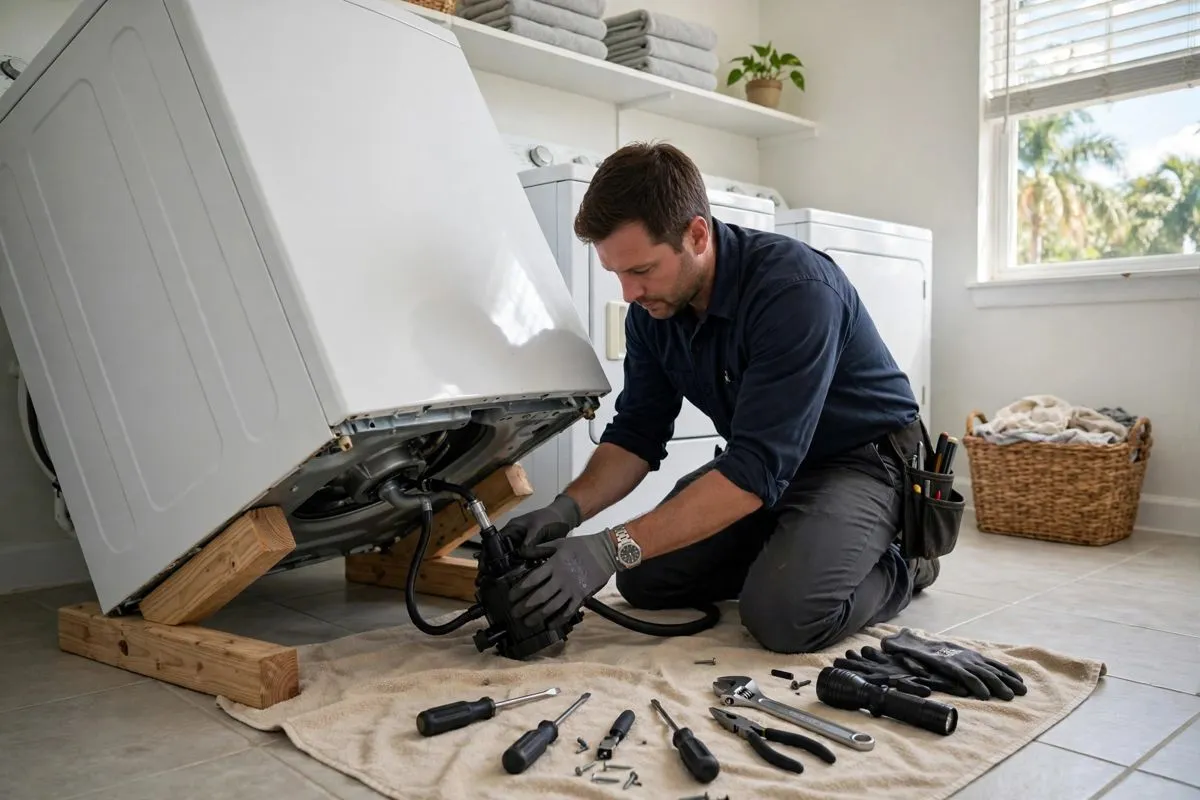
Jupiter's water is mineral-heavy, and those minerals do not pass through your appliances harmlessly — they settle out as hard white scale inside washer inlet valves, drain pumps, hoses and detergent drawers. The damage is slow and quiet: fills get slower, drains get weaker, cycles run longer, until one day a valve or pump fails outright. The good news is that scale is one of the most manageable washer problems in Jupiter — if you catch it while it is still a cleaning job and not a part replacement.
How does hard water actually damage your washer?
Every time hot or pressurized water moves through a small opening, minerals can deposit on the edges of that opening. Washers are full of small openings: the mesh screens and solenoid ports in the inlet valve, the drain pump filter, the narrow hoses and the detergent drawer jets. Scale narrows those openings a little at a time. Flow drops, pumps and valves work harder and run longer — and parts that should last a decade give up years early. Homes on well water around Jupiter Farms often see it fastest, because well water skips some of the treatment municipal water gets.
Which washer parts does Jupiter hard water hit hardest?
The inlet valve: slow fills and valve failures
The classic sign is a washer that takes noticeably longer to fill than it used to, or fills with a thin, weak stream. Sediment and scale clog the inlet valve screens, and eventually the valve itself sticks — sometimes closed (no fill, or an error code mid-cycle) and sometimes slightly open, so water slowly seeps into the tub when the machine is off. Front-loaders in hard-working family homes around Abacoa and Egret Landing are weekly calls for us. Our washer repair page covers the valve replacement itself.
The drain pump and hoses: weak drains and standing water
Scale attacks the drain side the same way it attacks the fill side. The pump filter clogs, hoses stiffen and narrow, and water that should pump out in a minute lingers in the drum — or never leaves at all. A pump that hums but moves little water, or a cycle that ends with standing water, usually means the drain side has scaled past cleaning. Our drain pump repair page covers the replacement itself.
The drum, drawer and seals: buildup you can see
Scale also shows up where you can see it. The detergent drawer crusts over so detergent stops dissolving fully, white flakes appear in the drum and on the door boot, and the boot seal itself stiffens and starts to seep. White residue on dark clothes after a wash is often the first sign. In coastal neighborhoods near Jupiter Inlet Colony, scale combines with salt-air corrosion and lines age even faster. Left alone, a crusted boot seal leaks — see our washer leaking page for what that repair involves.
What are the early warning signs of scale buildup?
- •Washer fills slowly, or the fill sounds weaker than it used to
- •White or chalky crust around the washer's water connections and detergent drawer
- •White residue on dark clothes after a wash, or detergent not dissolving fully
- •Washer draining slowly, or water left in the drum after a cycle
- •Grit or white flakes in the drum or on the door seal after a cycle
- •A musty smell from the drum or door boot that survives cleaning cycles
What can you safely clean yourself?
Plenty — scale maintenance is one of the better DIY jobs, as long as you stay on the outside of the machine's sealed parts:
- •Clean the washer inlet screens. Turn off both water valves, unscrew the fill hoses from the back of the washer, and rinse the small mesh screens inside the valve ports (a soft toothbrush helps). Reconnect carefully and check for leaks.
- •Run an empty hot vinegar cycle in the washer. Add a cup of white vinegar to the detergent dispenser and run an empty hot cycle. It dissolves light scale in the drum, hoses and drawer.
- •Soak the detergent drawer. If your washer's drawer lifts out, soak it in vinegar and clear each jet with a toothpick — never a metal pin, which can enlarge the jet.
- •Clean the drain pump filter. Open the pump filter access (usually low on the front), place a tray underneath, and rinse the filter clear of lint, coins and scale. A clean filter is what keeps drains strong.
- •Use the right detergent dose. In hard water, more detergent usually leaves residue worse, not better. A measured dose genuinely helps here.
Two cautions. Go easy with vinegar around rubber seals and door gaskets — occasional cycles are fine, but constant acid exposure ages rubber; wipe seals down with plain water afterward. And never pour descaling chemicals into a washer's inlet valve or pump lines: if a part needs internal descaling, it is already past the point where chemicals will save it.
When does scale mean the part is done?
Cleaning removes loose deposits. It cannot restore a valve whose solenoid has been straining against a clog for a year, or an element whose crust has already caused hot spots and warping. Call a technician when:
- •The washer still fills slowly after the screens are clean — the valve body itself is scaled or failing
- •Water seeps into the tub when the washer is off (a valve that no longer seals; do not ignore this one — it can overflow)
- •The drain pump hums but moves little water, even with a clean filter
- •The drum has heavy scale you can feel, or the door boot is crusted and leaking
- •Any scaled connection is leaking — scale often hides corrosion underneath it
These are part replacements, and they sit at the modest end of local pricing — see the washer repair cost guide for what valves, pumps, and hoses typically run in Jupiter. Catching them at this stage is exactly how you avoid the bigger bill later.
Is Jupiter's water really hard enough to damage washers? ▾
Yes — Jupiter's supply carries enough mineral content that scale buildup is one of the most common slow failures we see in washers here. It rarely kills a machine in a year, but unaddressed it shortens the life of valves, pumps, and hoses noticeably, especially in homes on well water.
How often should I descale my washer? ▾
For most Jupiter homes, an empty hot vinegar cycle every one to two months keeps washer scale in check, and checking washer inlet screens twice a year is enough. Homes on well water, or households running many loads a week, should do both more often — let the warning signs above be your schedule.
Can I use vinegar in my washing machine too? ▾
An occasional empty hot cycle with vinegar in the detergent dispenser helps with odor and light deposits in the drum and hoses. Just do not overdo it — frequent strong vinegar use can age door seals and hoses — and never use it as a substitute for cleaning the inlet screens, which is where the fill problems actually start.
Why are my clothes coming out with white residue? ▾
White residue on clothes almost always means hard-water scale plus detergent overdose: scale in the drawer and inlet screens keeps detergent from dissolving fully. Start with a measured dose, a clean drawer and clean inlet screens. If residue persists, the inlet valve itself has scaled past cleaning and needs replacement.
Will a water softener fix all of this? ▾
A softener (or a point-of-use filter on the washer's supply line) genuinely slows new scale formation and is worth considering if you are replacing appliances or renovating. It will not undo damage already done — a scaled valve stays scaled — so existing symptoms still need cleaning or repair first. Hard water is a slow problem with a fast fix — when it is caught early. If your washer is filling slowly, draining weakly, or leaving residue on clothes, call Jupiter Washer Pros at (561) 316-0595. We will clean what can be cleaned, tell you honestly when a part is finished, and give you a fixed quote before any work begins. Book through our contact page or browse all services.
Dealing With This Problem Right Now?
Our Jupiter technicians diagnose it in your home and quote the full price before any work begins. Call (561) 316-0595.